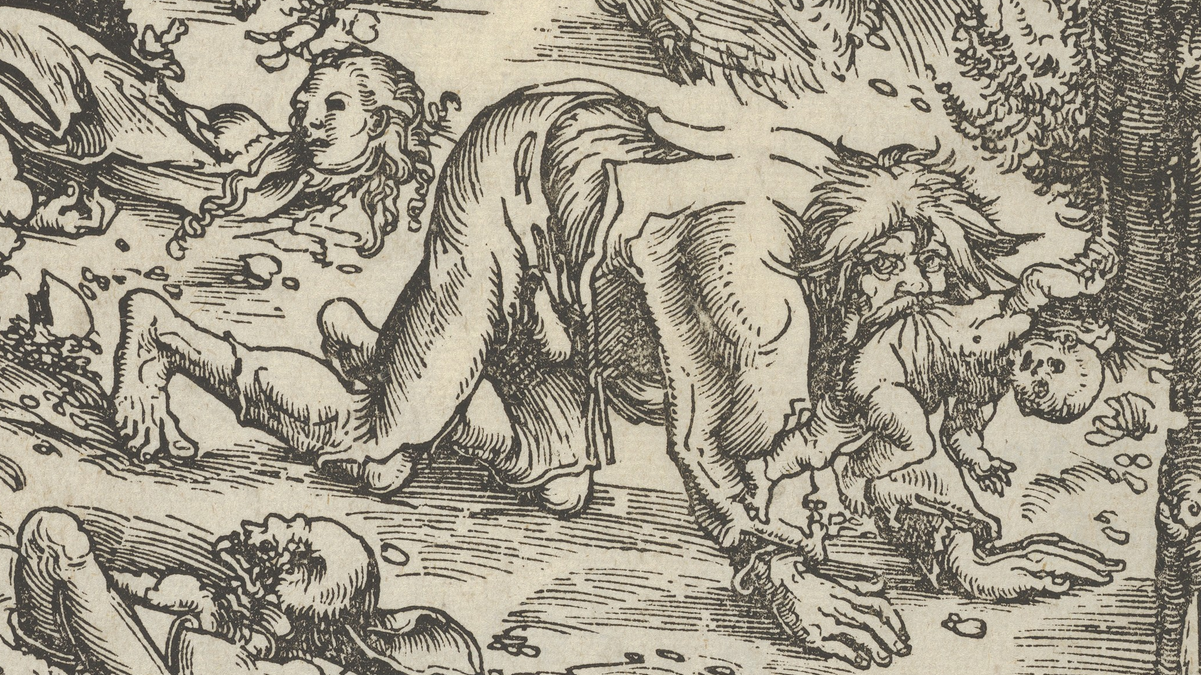


“Be good, or the loup-garou will get you!” With roots in medieval France (Merriam-Webster cites the earliest use of the term circa 1580), tales of this lycanthrope have frightened French and Canadian children for generations. Stemming from the Old French words loup (wolf) and garou (a man who transforms into a wolf), the loup-garou was essentially a werewolf: a person cursed to transform into a wolf-like creature, but their affliction “may also take the form of a calf or small ox, a pig, a cat or even an owl.” (source)

Unlike tales of lycanthropy being transmitted through a werewolf’s bite, the loup-garou’s transformation is occasionally the result of being cursed by a witch, but more often than not is due to a religious infraction. From The Canadian Encyclopedia: “In the French Canadian tradition, a Loup-Garou is often guilty of not being a good Christian. For example, people who did not confess during Easter could be cursed to become werewolves.” As cautionary tales, stories of the loup-garou highlighted the dangers of not conforming to religious and/or societal norms, and their popularity in the Middle Ages is a prime example of the Church’s intense need to maintain social control.
Moral panic has been defined as “…a mass movement based on the false or exaggerated perception that some cultural behaviour [sic] or group of people is dangerously deviant and poses a threat to society’s values and interests.” (source) And like the tales of the loup-garou, contemporary examples of moral panic seem just as fantastic, untethered from reality. However, I think there is something valuable we can take away from the loup-garou’s story. While some versions of the folktale say that the individual will be cursed for 101 days, in another variation of the story the curse can only be broken when someone recognizes the loup-garou. It is seeing the humanity in another that breaks the curse.

Did you enjoy this feature? Check out other entries in the Folklore Files…


Something went wrong. Please refresh the page and/or try again.
